1890 — On September 6, 1890, Louisa Ann Swain of Laramie, Wyoming becomes the first woman to cast a vote in a general election. In 1890, Wyoming, with a Republican governor and Democratic legislature, insisted it would not accept statehood without keeping women’s suffrage.
Passage of the 19th Amendment
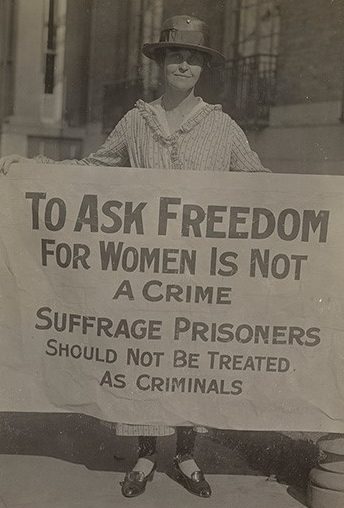
First introduced to Congress in 1878, the women’s suffrage amendment failed several times. In 1915, the amendment failed again without President Wilson’s support.
The United States’ entry into WWI, in 1917, helped to shift public opinion about women’s suffrage and role in the country. NASWA argued women should be rewarded with the right to vote for their patriotic wartime service.
In 1918, another bill was introduced, this time with President Wilson’s support. The 1918 Suffrage Bill passed the House with only one vote to spare but failed the Senate by two votes.
With increasing pressure from the public, lawmakers in both parties were anxious to pass the amendment and make it effective by the 1920 general election. To try and get the amendment passed in time for the next year’s election, President Wilson called a special session of Congress and in the spring of 1919, The House of Representatives passed the amendment followed by the Senate just a few months later.
The amendment was then submitted to the states for ratification, where it would require the approval of 36 states (three-fourths of states) to be adopted as a Constitutional Amendment. Within just a few days, several states ratified the amendment since their legislatures were actively in session. Additional states ratified at a regular pace until March 1920 when the number of states stalled at 35 for five months.
“GOOD BOY”
In the summer of 1920, the Tennessee State Senate voted to ratify the amendment, but the State House of Representatives still had to vote. A young state representative, Harry Burns, wore an anti-suffragist pin and voted against the amendment in what would be a tie vote. Harry had been internally conflicted so when a letter from his mom was delivered to him in the chambers before the revote, he took her advice. His mother urged him to “be a good boy” and vote for the amendment. In the revote, Burns cast the tie-breaking vote making Tennessee the 36th state to ratify the amendment allowing the 19th amendment to be adopted and officially become part of the U.S. Constitution on August 26, 1920..
On paper, the Amendment protected discrimination against all women, but in practice, it only gave white women the right to vote. Black women, Native American women, Asian American women, and women from other racial and ethnic minority groups were discriminated against for 45 more years until the passage of The Voting Rights Act of 1965 (VRA). The VRA afforded crucial protections to Black, Indigenous, and Women of Color (BIWOC) voters.
I know the ho hum history of it all may be boring, but if I were alive and thought not fit to vote, it would be another story, as far as my involvement was concerned. Familiarizing ourselves with the reality of the recent past should make us more mindful of current ways that women are oppressed, and to vote seriously.
___________________
ALTHOUGH I JUST RETURNED FROM AN ECLIPSE, I had to get this off before turning in. More tomorrow.
________________________
OH YES: While I was musing over my “pages” listed way above, I re-read the one on SECRETS and was interested again. Moreover, I thought I had lost the extended section after 48 items, but found them still there, after a couple of blank spots continuing through entry 81. The world is certainly an interesting place, which brings to mind an earlier poem:
LETTING GO
I don’t believe in anything
but appreciate a lot.
I’m thankful for myself and the
organ music in my ear,
for the existence of all
my family, bless-’em.
Others’ frailings are okay ’cause
they’re just caught in their own net.
We need to feel good about ourselves,
’cause we’re all we’ve really got.
nan






 NANMYKEL.COM